Our Lady of Perpetual Succour
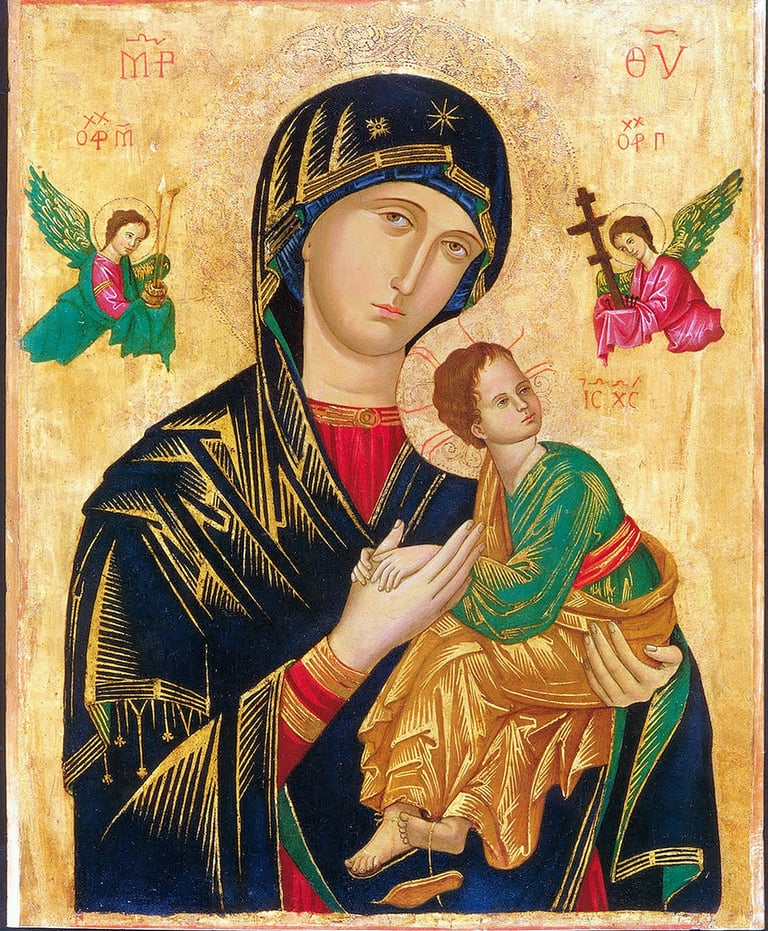
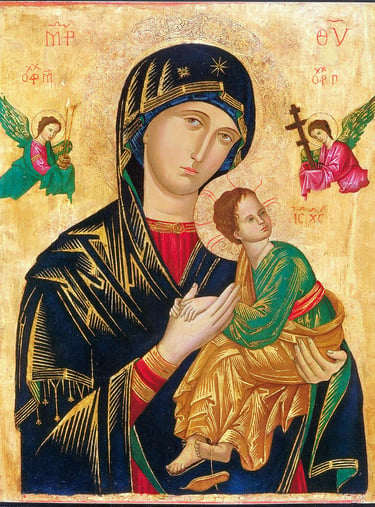
The picture of Our Lady of Perpetual Succour (also called Our Lady of Perpetual Help) is one of the most famous Marian icons in the Catholic Church. It is a Byzantine-style icon that is rich in symbolism, with every detail carrying a spiritual meaning.
The original icon is preserved in Church of Saint Alphonsus Liguori and has been entrusted to the Congregation of the Most Holy Redeemer.
Catholics pray before this icon asking Mary for:
Protection.
Guidance.
Strength in suffering.
Help during difficulties.
Closer union with Christ.
The icon is therefore not merely a painting; it is a visual summary of Christian faith, showing Jesus the Redeemer and Mary as the loving Mother who continually helps her children.
The Central Figures
Mary (The Virgin Mother)
Mary occupies the center of the icon. She is shown holding the Child Jesus securely in her arms.
Her face is serious and contemplative.
She looks outward toward the viewer rather than directly at Jesus.
This gaze symbolizes that Mary presents Jesus to humanity and invites believers to approach Him.
She is depicted as both:
The Mother of Jesus.
The Mother and protector of all believers.
The Child Jesus
Jesus appears as a young child running toward His mother in fear.
He has seen the instruments of His future Passion carried by the angels. His frightened movement toward Mary shows:
His true humanity.
His dependence upon His mother.
The comfort Mary provides.
One of His sandals is falling from His foot, which is one of the most recognizable features of the icon.
The loose sandal is often interpreted as:
The haste with which He ran to His mother.
Human fear and vulnerability.
Complete trust in Mary.
The Two Angels
Archangel Michael (left side)
The angel on the left is usually identified as:
Saint Michael the Archangel
He carries:
The lance.
The sponge.
The vessel of vinegar.
These are instruments connected with Christ's Passion.
Archangel Gabriel (right side)
The angel on the right is:
Saint Gabriel the Archangel
He carries:
The cross.
The nails.
These also symbolize the suffering and crucifixion of Jesus.
The angels remind the Child Jesus of the sacrifice He will one day make.
Mary's Clothing
Dark Blue Mantle
Mary's dark blue outer garment represents:
Purity.
Heavenly dignity.
Queenship.
Blue has traditionally been associated with the Blessed Virgin.
Red Tunic
The red garment beneath symbolizes:
Love.
Sacrifice.
Participation in Christ's suffering.
The Star on Mary's Veil
A prominent star appears on Mary's forehead.
This symbolizes:
Mary as the "Star of the Sea."
Her role as a guide who leads people safely to Christ.
Hope during life's difficulties.
The Hands
Mary's right hand points toward Jesus.
This gesture means:
Jesus is the way to salvation.
Mary always leads believers to her Son.
Jesus tightly grasps Mary's thumb, showing:
Trust.
Dependence.
The comfort of a mother.
The Golden Background
The gold background is typical of Byzantine icons.
It represents:
Heaven.
God's eternal kingdom.
Divine glory.
The icon is not intended to depict an earthly scene but a spiritual reality.
The Greek Letters
The icon contains Greek abbreviations:
MP ΘΥ = "Mother of God."
IC XC = "Jesus Christ."
Initials near the angels identify Michael and Gabriel.
These inscriptions emphasize the icon's Eastern Christian origins.
Theological Meaning
The icon teaches several important messages:
Jesus truly became human and experienced fear and suffering.
Mary comforts and protects those who come to her.
Mary always points people toward Jesus.
Christ's Passion and Resurrection are central to salvation.
Believers can seek Mary's intercession in times of distress.
Why It Is Called "Perpetual Succour"
The word succour means help, assistance, or aid.
The title "Our Lady of Perpetual Succour" means:
Mary continually helps those who seek her intercession.